MARGARET R. THOMPSON’S FIRST SOLO EXHIBITION IN TÜRKİYE, “TEMENOS: THE INLAND SEA,” AT ZEYREK ÇİNİLİ HAMAM


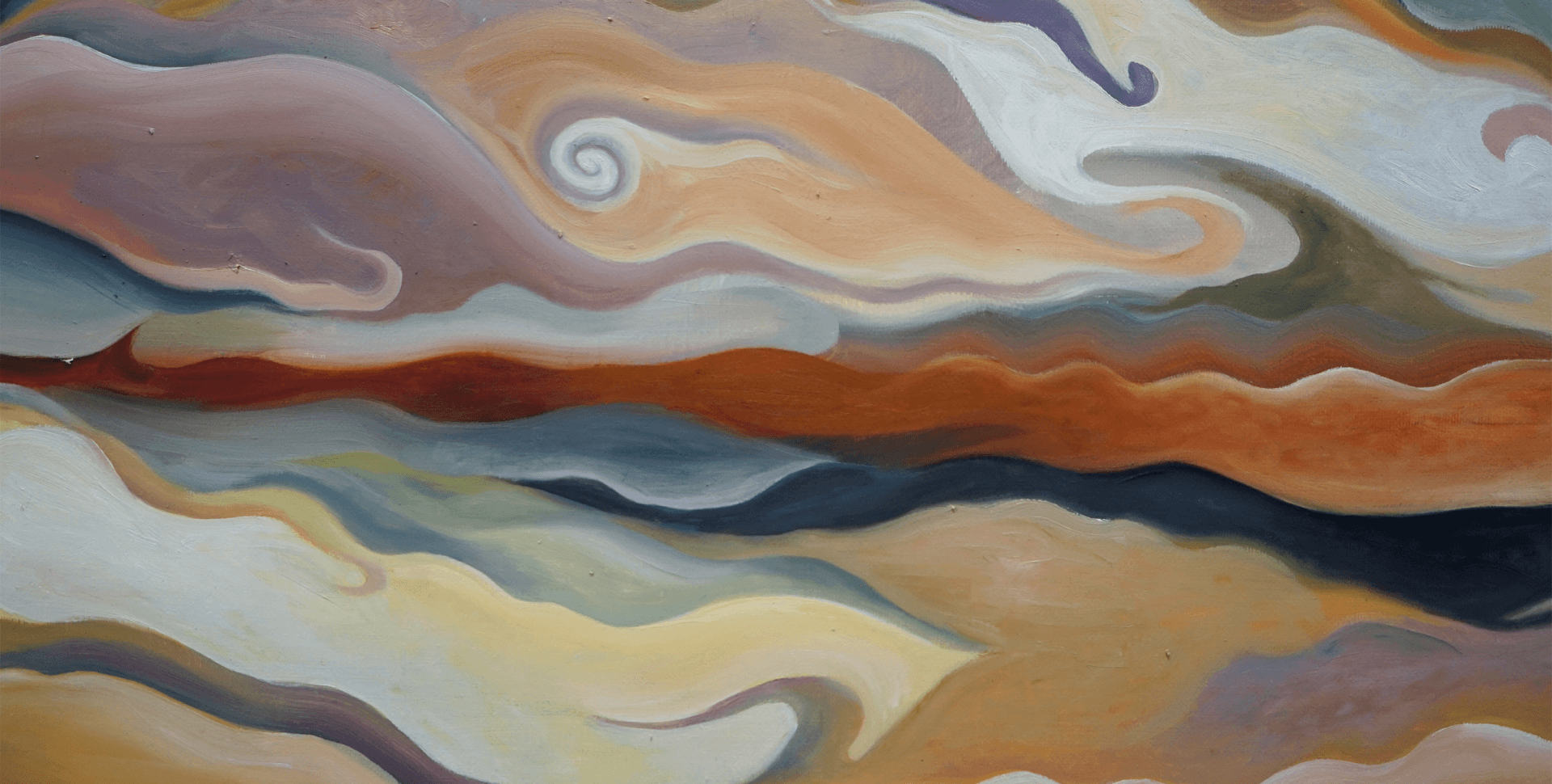
Temenos: The Inland Sea marks Margaret R. Thompson’s first solo exhibition in Türkiye, conceived for the Byzantine cistern beneath Zeyrek Çinili Hamam and curated by Anlam de Coster.
Composed of site-specific works, the exhibition brings together paintings on canvas and silk, along with sound and scent.
Margaret R. Thompson’s practice is rooted in wild landscapes and natural cycles. Her paintings unfold as perceptual fields where archetypal forms and primordial elements evoke deep time and the origins of life.
The exhibition draws on the ancient Greek term temenos, a sacred precinct set apart from everyday life, offering protection and a passage between the human and divine realms. As a sanctuary honoring a deity, it can take the form of temple grounds, a grove, or a spring. It was a building block of ancient societies, at once a holy site and a shelter for the marginalized.
Depth psychology later adopted temenos as an inner shelter where the unconscious can be safely approached, an alchemical vessel in which transformation may occur. In this exhibition, both dimensions of the term converge around a common premise: containment approached not as a limitation but as a condition of transformation.
Historically, the hammam itself functioned as a temenos: a heterotopia where social hierarchies dissolved and collective purification rituals transformed body and mind within a shared sanctuary. The cistern is the hammam’s portal to the subterranean and serves as the silent protector of unseen, dark waters. Within Byzantine culture, cisterns formed one of the city’s key infrastructural foundations: reservoirs designed to gather and hold what sustained life.
Thompson envisions the cistern as an inland sea and proposes descent as a conscious act, a move toward inward attention and depth. Bodily, psychic, and spatial, this sea is as much interior as it is geological: what Jung called the favorite symbol for the unconscious, the mother of all that lives.
The Sea of Marmara, an inland sea Thompson encountered during her research residency in Istanbul, carries this same interiority. Known in antiquity as the Propontis, “the sea before the sea,” it functioned as a gateway between worlds. Like the Propontis, the cistern and exhibition hold material, cultural, and psychological memory beneath their surfaces.
In Thompson’s practice, containment is approached as a sacred form of holding, closer to the womb than to the wall. The paintings act as vessels rather than autonomous objects. The hammam, as the exhibition’s container, can be understood as a feminine architecture of protection and care: warm, enveloping, porous, and alive; a space that receives rather than restrains.
Her paintings are structured through axial compositions, often with a central spine acting as a conduit. Urn-like forms, spirals, and vortices recur, suggesting cycles of dissolution and rebirth. In the cistern, these motifs frame the inland sea not as a landscape but as a cycle of circulation and transformation, a rhythm of ebb and flow within permeable boundaries. The polarity between the hammam’s celestial starry domes and the dark depths of the cistern is reflected in her work, which moves between elevation and immersion.
Winged chimeras, botanical forms, seashells, fossils, and celestial bodies surface intermittently across layered surfaces, yet Thompson’s visual language resists fixed narratives. Mythical presences act not as storytelling devices but as liminal guardians of the temenos. Her material vocabulary incorporates oils, spices, waters, and silks sourced in Istanbul, alongside natural pigments and earth she gathered from across the world.
A longer temporal horizon underpins this logic of containment. Life began in primordial waters before emerging onto land. For billions of years, the ocean held and nurtured all life. In order for terrestrial life to emerge, this condition was carried into the body as the womb’s environment. Thompson’s paintings move across these scales, from the cosmic to the bodily.
The exhibition extends beyond the visual, recalling the multisensory nature of sanctuaries. Developed in collaboration with Homemade Aromaterapi, a custom scent accompanies the exhibition. This gesture summons the role of fragrance in temples, where aromatic substances marked the transition from the ordinary to the ethereal. Like scent, sound operates as a threshold through which perception shifts.
Within a broader art-historical lineage, Thompson’s work can be placed in dialogue with artists engaged in esoteric traditions who treated the canvas as the interface between the seen and the unseen, such as Agnes Pelton, Remedios Varo, Leonora Carrington, Hilma af Klint, and Ithell Colquhoun.
This exhibition is the fifth project realized within the contemporary art program of Zeyrek Çinili Hamam, initiated by Koza Yazgan and continuing under the curatorship of Anlam de Coster. The program aims to sustain the historical social role of the hammam as a space of healing, belonging, and gathering through free and publicly accessible exhibitions and events.
The exhibition is open daily, except on Mondays, from 10:00 to 18:00, and runs until August 30, 2026. Admission is free.